
Got an old sofa taking up space? Need to clear unwanted furniture before moving out? Or are you preparing your home for renovation and unsure how to dispose of everything?
Finding the right disposal service in Singapore can make clearing unwanted items much easier. However, not every disposal option covers the same items, collection arrangements, or handling requirements. Your options may depend on what you need to remove, where you live, and how quickly you need the space cleared.
This guide explains the different disposal options available in Singapore, the factors that affect disposal costs, how to prepare for collection, and when to consider a private disposal service.
If you need help removing bulky furniture or unwanted household items, Easy Disposal can help you explore a suitable clearance arrangement. Contact us with photos of your items and your preferred collection date to get started.
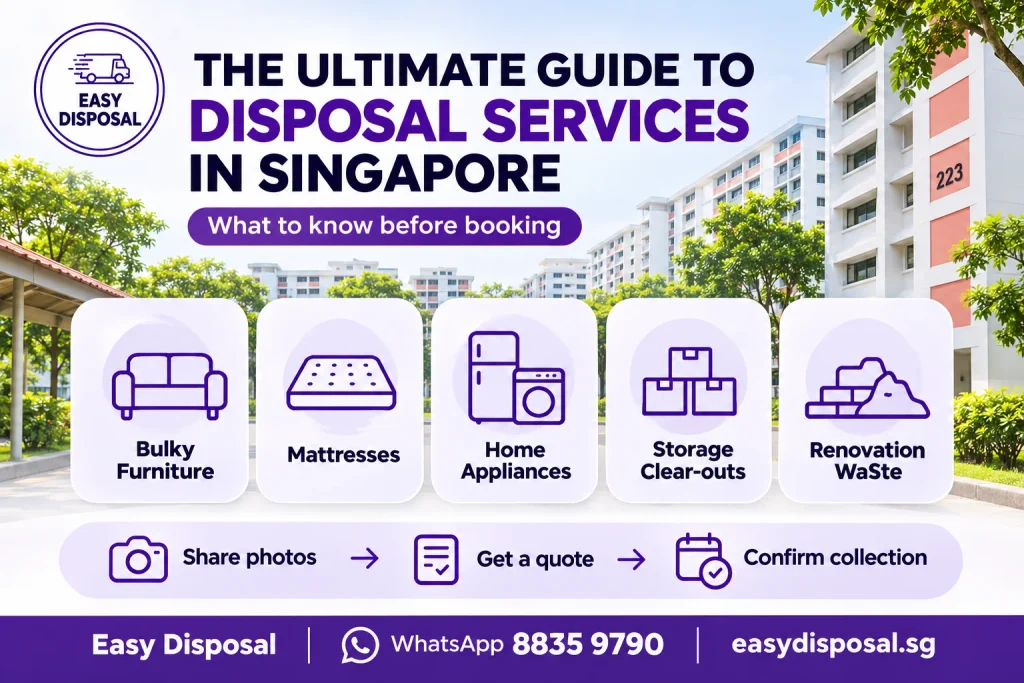
1. What Are Disposal Services in Singapore?
Disposal services help households and businesses remove unwanted items from their premises. Depending on the provider and the type of waste, the service may involve collecting, carrying, dismantling, transporting, and arranging the disposal of items.
Common reasons to arrange disposal include:
- Moving to a new home and leaving unwanted furniture behind
- Replacing old sofas, beds, wardrobes, and dining tables
- Clearing unused items from a self-storage unit
- Preparing a property for renovation
- Removing pest-damaged or heavily worn furniture
- Clearing a rental property before handing it back to the landlord
- Making space in an office, storeroom, or commercial unit
The best option depends on the items you need to remove and the amount of assistance you require.
For example, a household with one unwanted chair may not need the same service as a family clearing several rooms before moving. Likewise, removing furniture from inside a flat may require more handling than collecting items already placed at an approved collection point.
Before booking, consider the volume of items, access conditions, collection deadline, and whether any items need special handling.
2. What Types of Items Can You Dispose Of?
Different providers accept different items, so always confirm what your chosen service can collect before arranging a booking.
The following table covers common household disposal needs and what to consider for each.
| Item type | Examples | What to check before booking |
|---|---|---|
| Bulky furniture | Sofas, wardrobes, dining tables and bed frames | Dimensions, weight, dismantling requirements and access |
| Mattresses and beds | Single, queen and king mattresses, bed frames | Whether the frame needs dismantling and whether the mattress can pass through the lift or doorway |
| Large appliances | Refrigerators, washing machines and dryers | Whether a dedicated appliance collection or e-waste service is suitable |
| Storage items | Shelving, unused furniture, boxes and household belongings | Storage facility access rules, collection permissions and loading arrangements |
| Office furniture | Desks, chairs, cabinets and meeting tables | Building requirements, quantity and access to the loading area |
| Renovation materials | Tiles, concrete, timber and other construction debris | Whether a contractor or approved renovation-waste disposal arrangement is required |
| Pest-damaged furniture | Furniture affected by suspected termites or other pests | Condition, infestation concerns and any special handling requirements |
Important: Not every disposal service accepts every item. Contact the provider with a complete list and clear photos before confirming your booking.
For large household appliances and electronic equipment, you may also have dedicated collection or recycling options. The National Environment Agency (NEA) provides guidance on household e-waste collection through its official e-waste recycling guide.
3. Which Disposal Option Should You Choose?
Singapore residents can explore several options for getting rid of unwanted items. The right choice depends on your property type, the items involved, and whether you need help carrying them out.
Compare your disposal options
| Disposal option | Best suited for | Key considerations |
|---|---|---|
| Town Council bulky-item collection | Eligible bulky household items in participating HDB estates | Check item limits, collection dates, fees and whether you must move items to a designated point |
| Public Waste Collector or licensed waste collector | Suitable bulky items in private residential estates | Confirm accepted items, service arrangements and applicable charges |
| Dedicated e-waste collection | Eligible electronics and electrical equipment | Check which products are accepted and whether doorstep collection is available |
| Donation or resale | Usable furniture and household items | Confirm that the recipient accepts the item and can collect it |
| Private disposal service | Bulky items, multiple items or clearances requiring additional handling | Confirm the collection scope, access requirements, quotation and available timing |
| Renovation contractor or approved waste arrangement | Construction and renovation debris | Confirm who is responsible for collection and disposal, including any required permits or approved sites |
NEA advises HDB residents to contact their Town Council regarding bulky-item removal. For private residential estates, residents can contact their appointed Public Waste Collector or a licensed waste collector. Fees and arrangements vary. You can review the official guidance on bulky-item disposal in Singapore.
When should you consider a private disposal service?
A private disposal service may be worth considering when:
- You have several bulky items to clear at once.
- You need help carrying furniture out of your home.
- You are working towards a moving or tenancy deadline.
- You need to clear items from a storage unit.
- You have large or awkward furniture that requires an access assessment.
- You want to discuss a collection arrangement for items that fall outside your usual public collection service.
If you are unsure which option suits your situation, start by listing everything you need removed. This makes it easier to check availability, compare arrangements, and request an accurate quotation.
4. How Much Do Disposal Services Cost in Singapore?
Disposal costs vary depending on the service provider, the items involved, and the work required.
Some public collection services may be available at no charge to eligible residents, subject to their respective rules. Private disposal services generally assess the job based on the items and collection requirements.
There is no single price that applies to every disposal job.
Factors that can affect your disposal quotation
| Cost factor | Why it matters |
|---|---|
| Number of items | A larger clearance may require more manpower, vehicle space or handling time |
| Size and weight | Large or heavy furniture may require additional manpower or special handling |
| Dismantling | Furniture that needs to be taken apart may require extra work |
| Floor level and lift access | Stairs, narrow lifts and difficult access routes can affect the collection arrangement |
| Carrying distance | The distance between the items and the loading point may affect the work involved |
| Item condition | Damaged, pest-affected or unusual items may need further assessment |
| Type of waste | Electronics, renovation debris and other specialised waste may require different arrangements |
| Collection timing | Urgent requests depend on availability and the provider’s scheduling arrangements |
How to get a more accurate quotation
Before requesting a quote, prepare the following information:
- Photos of your items: Take clear photos of every item you want removed.
- An item list: Include the type and approximate quantity of each item.
- Your location: State whether you live in an HDB flat, condominium, landed property or another type of premises.
- Access details: Mention the floor level, lift availability, stairs and any loading restrictions.
- Your preferred date: Share your intended collection date and any deadline.
- Additional requirements: Explain if the items need dismantling or require special handling.
Providing these details upfront helps the provider assess the work more accurately.
When comparing quotations, check whether each provider includes the same items and handling requirements. Ask about additional charges before confirming the booking so you know what the agreed price covers.
Need a quotation for your unwanted furniture? WhatsApp Easy Disposal at 8835 9790 with your item photos and collection details.
5. How to Arrange Bulky Item Removal Quickly
Sometimes, disposal cannot wait. You may need to clear furniture before your tenancy ends, remove damaged items, or make room for renovation work.
Although urgent collection depends on availability, preparing the necessary details early can help the booking process move more smoothly.
Step 1: Contact a disposal provider early
Once you know which items need to go, contact your chosen provider. If you have a fixed deadline, such as a property handover, mention it immediately.
Do not assume that a provider can accommodate a same-day request until the collection time and scope have been confirmed.
Step 2: Send photos and an item list
Photos help the provider understand the volume and condition of the items. Include wide shots showing the overall clearance and close-ups of large or difficult pieces.
If you have multiple items, group them into a simple list rather than describing everything in a long message.
Step 3: Explain your property’s access conditions
Tell the provider whether the items are located in an HDB flat, condominium, landed home, office or storage facility.
Mention whether the items can fit through the lift and doorways, whether stairs are involved, and whether the building requires advance booking for loading or lift use.
These details are especially important when removing large sofas, wardrobes, mattresses and appliances.
Step 4: Confirm the quotation and collection slot
Before agreeing to the service, confirm the items included, the total quoted price, the collection date and any additional charges.
If you are working towards a deadline, make sure the collection slot is explicitly confirmed rather than relying on an estimated response time.
Step 5: Prepare the items before collection
Remove personal belongings from drawers, cupboards and storage compartments. Separate items you intend to keep from those marked for disposal.
Keep the access route clear and confirm any lift or loading-area arrangements with your building management.
Preparing in advance helps reduce confusion and makes collection easier to coordinate.
6. Disposal Tips for Different Situations
Not every clearance follows the same process. Here are a few common situations and what you should consider before arranging disposal.
Moving out of an HDB flat or condominium
Moving is a good time to decide which furniture you want to bring to your next home.
Start sorting early, especially if you have large items that may be difficult to move. Measure bulky furniture where necessary and check whether it can pass through the lift, doorway and corridor.
If you need to dispose of several items before your handover date, contact a disposal provider early to discuss the collection arrangements.
For eligible items, you can also check with your Town Council about available bulky-item collection services.
Clearing unwanted items from a self-storage unit
Storage units can accumulate furniture, boxes and belongings that you no longer use.
Before arranging a clearance, check the facility’s access hours, vehicle restrictions, loading rules and whether a booking is required. Make sure you have permission to arrange collection from the unit.
Prepare a list of everything you want removed and identify any items that should remain in storage.
Removing termite-infested or pest-damaged furniture
Furniture affected by termites or other pests may need prompt attention, particularly if you suspect an active infestation.
Avoid moving affected furniture through your home unnecessarily, as this may spread pests or debris. Consult a qualified pest-control professional about managing the infestation, and tell your disposal provider about the item’s condition before booking.
Removing the furniture alone may not resolve an active infestation, so address the underlying pest issue as well.
Clearing a property before renovation
Before renovation begins, identify which furniture and household items need to go and which materials will be generated by the renovation itself.
These are not necessarily handled through the same disposal arrangement. HDB’s renovation guidance explains that renovation debris must follow the applicable Town Council arrangements or be removed by the renovation contractor to an NEA-approved site where required.
Read HDB’s official renovation and debris disposal guidance before planning your clearance.
Removing bulky items from a high-rise home
Large furniture can be difficult to manoeuvre through narrow doorways, lifts and staircases.
Measure the item’s dimensions where possible, check the lift’s internal dimensions and doorway clearance, and tell your provider if dismantling may be necessary.
Do not attempt to lower furniture from a window or balcony yourself. Such attempts can cause serious injuries and damage property.
7. Common Disposal Mistakes to Avoid
A little preparation can help prevent delays, unexpected charges and problems on collection day.
Leaving items in common areas without an agreed collection arrangement
Furniture left beside refuse areas, in lift lobbies or along corridors can obstruct shared spaces and escape routes. Arrange collection first and follow your property’s rules.
Assuming all bulky items qualify for free collection
Public collection services have their own eligibility rules and limitations. Check with your Town Council or relevant waste collector before relying on a particular arrangement.
Mixing different waste types together
Ordinary furniture, electrical equipment and renovation debris may require different disposal routes. Tell your provider what you have instead of assuming everything can go in one load.
Booking without sharing access details
A sofa that fits through the front door may not fit inside the lift. Mention stairs, narrow passages, loading restrictions and dismantling requirements before confirming the job.
Waiting until the last minute
A last-minute request may limit your available collection options. Contact a provider early, especially when working around a tenancy deadline, renovation schedule or property handover.
Failing to confirm the final price
Make sure you understand the quotation and any potential additional charges before collection begins. Confirm any changes to the agreed scope before the provider carries out extra work.
8. Why Choose Easy Disposal for Your Clearance?
Clearing bulky items can be physically demanding and time-consuming, especially when you have several pieces of furniture or a fixed deadline.
Easy Disposal helps households in Singapore explore a practical way to remove unwanted bulky items. Whether you are moving, clearing a storage unit or making space at home, you can contact our team to discuss your requirements.
When enquiring, share photos of the items, your location, the property’s access conditions and your preferred collection date. This helps us assess your request and advise on the available arrangements.
How to get started
- Take photos of the items you want removed.
- Prepare a list of the items and their approximate quantities.
- Share your location, floor level and lift or stair access details.
- Tell us your preferred collection date and any deadline.
- Confirm the quotation and collection arrangements before proceeding.
For urgent clearances, contact us as early as possible. Collection timing depends on availability and the requirements of each job, so please confirm your slot with our team.
Ready to clear your space?
📲 WhatsApp Easy Disposal at 8835 9790
🌐 Visit easydisposal.sg to learn more and enquire about our disposal services.
Frequently Asked Questions About Disposal Services in Singapore
1. How do I book a disposal service with Easy Disposal?
You can WhatsApp Easy Disposal at 8835 9790 or visit easydisposal.sg to enquire. Send photos of your items, your location, access details and preferred collection date so the team can assess your request and advise on the next steps.
2. How quickly can Easy Disposal collect my items?
Collection timing depends on availability, the number and size of items, and the access conditions at your property. If you need urgent removal, mention your deadline when enquiring so the team can check the available arrangements.
3. What information should I provide when requesting a disposal quote?
Provide clear photos, an item list, your location, floor level, lift availability and preferred collection date. Mention any dismantling requirements, stairs, building restrictions or special handling concerns. These details help the provider assess the job.
4. Can I arrange bulky item removal from an HDB flat?
Yes, you can enquire about private bulky-item removal from an HDB flat. You should also check your Town Council’s collection service, as eligibility, item limits, fees and collection arrangements vary by estate.
5. Can Easy Disposal remove furniture from a condominium or landed property?
You can enquire about collection from different property types in Singapore. Share your property’s access conditions, including lift or stair access, loading restrictions and any management requirements, so the team can assess your request.
6. Can I arrange same-day bulky item removal?
Same-day collection may be possible depending on the provider’s schedule and the requirements of the job, but it is not guaranteed. Contact Easy Disposal with your item list, photos and preferred timing to check availability.
7. Can I dispose of a mattress, sofa or wardrobe?
These are common bulky household items, but acceptance and handling arrangements depend on the provider and the specific item. Send Easy Disposal photos and details of the furniture you want removed so the team can assess your request.
8. Can I use a disposal service for renovation debris?
Renovation debris may require a separate disposal arrangement from ordinary household furniture. Check with your renovation contractor and Town Council, and consult HDB’s renovation guidance where applicable. Tell Easy Disposal what materials you need removed so the team can advise whether your request is suitable.
9. Can I book disposal for items stored in a self-storage unit?
You can enquire about removing unwanted belongings from a storage unit. Share the facility location, item photos and any access or collection rules set by the storage provider before confirming the booking.
10. Should I donate unwanted furniture or arrange disposal?
If your furniture is in usable condition, consider resale or donation first. Confirm that the recipient accepts the item and can arrange collection. If the furniture is damaged, unsuitable for reuse or needs to be removed by a deadline, enquire about an appropriate disposal arrangement.
11. Do I need to dismantle furniture before collection?
Not necessarily. Requirements depend on the item, its dimensions and the provider’s service scope. Share photos and mention whether the furniture is built-in, unusually large or difficult to move. Confirm any dismantling work and charges before booking.
12. What should I do before the disposal team arrives?
Remove personal belongings from the items, identify what should be kept and what should be removed, and clear the access route. Confirm any lift or loading arrangements with your building management. Keep the agreed item list available so you can check the scope with the team.
References and Useful Resources
For the latest rules and collection arrangements, refer to these official Singapore resources:
- National Environment Agency (NEA): Disposal of Bulky Items, Garden Waste and Dead Pets
- National Environment Agency (NEA): Where to Recycle E-Waste
- Housing & Development Board (HDB): Important Information on Renovations
- Ministry of Sustainability and the Environment (MSE): Written Reply to Parliamentary Question on Disposal of Bulky Waste
Collection rules, eligibility and charges may change, so confirm the latest arrangements with the relevant authority or service provider before booking.
Need Help Clearing Bulky Items?
You don’t have to manage every part of a clearance alone. Whether you’re preparing for a move, replacing old furniture or clearing unwanted belongings, planning ahead can help you find an arrangement that suits your needs.
Contact Easy Disposal to enquire about bulky item removal in Singapore.